Overview
Customer.io and Ortto both target growth-stage companies needing marketing automation, but with different approaches. Customer.io is event-driven - track user behaviors, segment based on events, trigger messages when things happen. Ortto is journey-driven - visualize customer paths, build flows that marketers can understand at a glance.
Event-Driven vs Journey-Driven
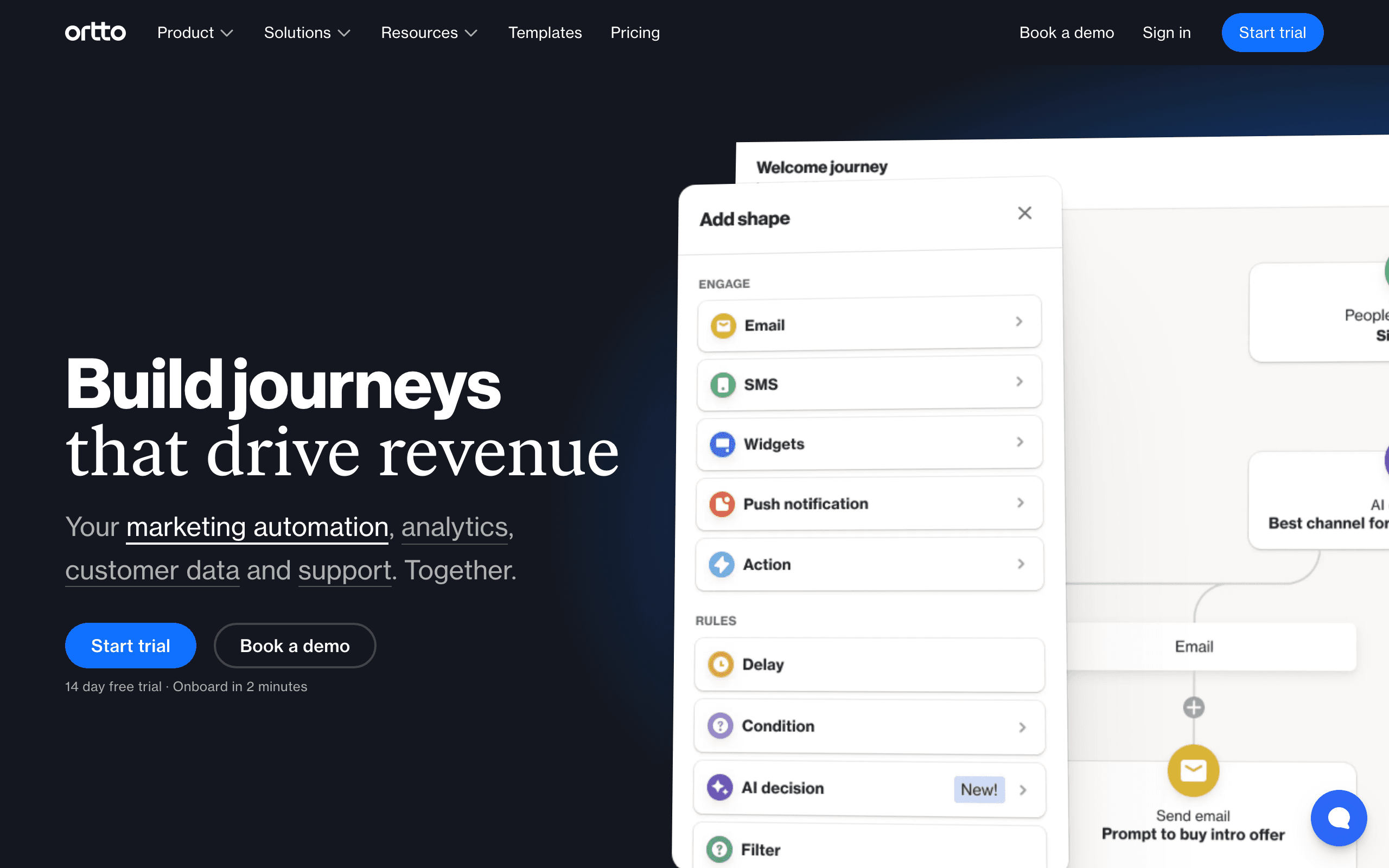
Customer.io starts with "what did the user do?" Every automation begins with events - signups, purchases, feature usage, custom events you define. Ortto starts with "what path should the user take?" Visual journeys map the customer experience from start to finish. Both work, but they represent different mental models.
Technical Requirements
Customer.io requires engineering to implement properly. Event tracking, custom attributes, API integration - you need dev resources to unlock the platform's power. Ortto is more marketer-friendly. The visual journey builder lets marketing teams build automations without engineering support.
Pricing Reality
At 10,000 contacts, Customer.io costs ~$145/month (Essentials + overage). Ortto costs $509/month (Professional plan required for 10k contacts). That's a 3.5x price difference for similar functionality. Ortto's Starter plan caps at 5,000 contacts for $199/month - the jump to Professional is steep.
Feature Depth
Both platforms offer multi-channel messaging (email, SMS, push), segmentation, A/B testing, and analytics. Customer.io has deeper behavioral segmentation and event logic. Ortto has better journey visualization and funnel analysis. They're close in overall capability, which makes Customer.io's lower price notable.
The SaaS Alternative
Neither Customer.io nor Ortto has native Stripe integration. Both lock transactional email behind expensive plans (Customer.io Premium at $1,000/month, Ortto Enterprise). Sequenzy offers event-driven automation with native Stripe integration and transactional email at $49/month - 90%+ cheaper than Ortto.
Making the Choice
Choose Customer.io if you have engineering resources and want sophisticated behavioral automation at a reasonable price. Choose Ortto if your marketing team needs self-service journey building and budget isn't the primary concern. Or choose Sequenzy for SaaS-focused automation at a fraction of either cost.
The Marketer vs Engineer Question
The fundamental question when choosing between Customer.io and Ortto is who will build and maintain your automations. If marketing owns the process without engineering support, Ortto's visual journey builder is genuinely more accessible. Marketers can drag, drop, and visualize entire customer flows without writing code or filing engineering tickets.
Customer.io's power comes from its event-driven architecture, but that power requires engineering investment. Someone needs to implement event tracking, define custom attributes, and configure the data pipeline. Once that foundation exists, Customer.io's automation is more precise. But the foundation takes weeks, not hours, and requires ongoing engineering attention as your product evolves.
For companies where marketing and engineering collaborate closely, Customer.io is the stronger choice. For companies where marketing needs to operate independently, Ortto removes the engineering bottleneck — at a premium price.
The 3.5x Price Premium
Ortto's $509/month versus Customer.io's $145/month at 10,000 contacts is a striking difference. That $364/month gap — over $4,300 annually — buys you Ortto's visual journey builder, marketer self-service, and slightly better journey analytics. Whether that justifies a 3.5x premium depends entirely on your team structure.
If removing engineering dependency on marketing automation saves even a quarter of a developer's time, the math might work for larger companies. But for most growth-stage SaaS companies, that $4,300/year is better spent on the product itself. Customer.io delivers comparable automation outcomes with a different workflow — one that requires more technical involvement but costs dramatically less.
The pricing gap also creates a practical concern: Ortto's steep jump from Starter (5,000 contacts at $199/month) to Professional (10,000 contacts at $509/month) means scaling past 5,000 contacts triggers a significant budget increase that catches teams off guard.
Neither Platform Solves the SaaS Billing Problem
Both Customer.io and Ortto treat subscription billing as an afterthought. Neither has native Stripe OAuth integration, which means subscription events — trial expirations, payment failures, plan upgrades, cancellations — require custom engineering to pipe into either platform. For SaaS companies where billing lifecycle is the most critical automation trigger, this is a significant gap.
Sequenzy was built specifically for this use case. Native Stripe integration means subscription events automatically trigger sequences without middleware. When a trial is about to expire, when a payment fails, when a customer upgrades — these events drive automated email sequences out of the box. At $49/month versus Ortto's $509/month, the savings alone fund multiple other growth initiatives.
User Behavior Tracking
SaaS email marketing depends on understanding how users interact with your product. Customer.io and Ortto track user events differently. The depth of behavioral data determines how targeted your email automation can be.
Event tracking, feature usage monitoring, and activity scoring help you identify which users need onboarding help, which are ready to upgrade, and which are at risk of churning. Compare how each platform ingests and acts on this behavioral data.
Trial and Onboarding Optimization
Converting trial users to paid customers is critical for SaaS growth. Customer.io and Ortto handle onboarding email sequences differently. The ability to trigger emails based on specific product milestones creates more relevant communication.
Effective onboarding emails guide users to their activation moment. Compare how each platform lets you define milestones, segment by trial progress, and personalize onboarding content based on user behavior and plan type. For deeper billing integration, see Sequenzy's Stripe features.
Company-Level vs User-Level Communication
SaaS products often have multiple users within a single account. Customer.io and Ortto handle company-level targeting differently. Being able to group users by organization and trigger emails based on account-level events is essential for B2B SaaS.
Consider how each platform manages company attributes, aggregate usage data, and role-based communication. The ability to send different onboarding emails to admins vs team members, or trigger expansion revenue emails based on company-level metrics, matters for B2B growth.