
Overview
Mailmodo and Mailchimp represent different philosophies in email marketing. Mailmodo bets on AMP technology for interactive emails. Mailchimp bets on being a comprehensive marketing platform. See our Mailchimp comparison for more context.
The key question: Is in-email interactivity worth limited client support?
AMP Email Technology
Mailmodo's core innovation is AMP (Accelerated Mobile Pages) for email. This allows interactive elements inside the email itself - forms, surveys, quizzes, calendars, shopping carts. Recipients can take action without clicking through to a website.
This genuinely reduces friction and can improve conversion rates. Mailmodo claims 3x improvement for in-email forms versus traditional link-and-click approaches.
The Client Support Problem
AMP email only works in Gmail and Yahoo Mail. Outlook, Apple Mail, and most other clients don't support it. For these recipients, Mailmodo sends a fallback HTML email that looks normal.
This means your list splits into two experiences. Gmail users get interactive magic. Outlook users get standard emails with links. For B2B audiences that lean Outlook-heavy, Mailmodo's main selling point doesn't apply.
Marketing Platform Comparison
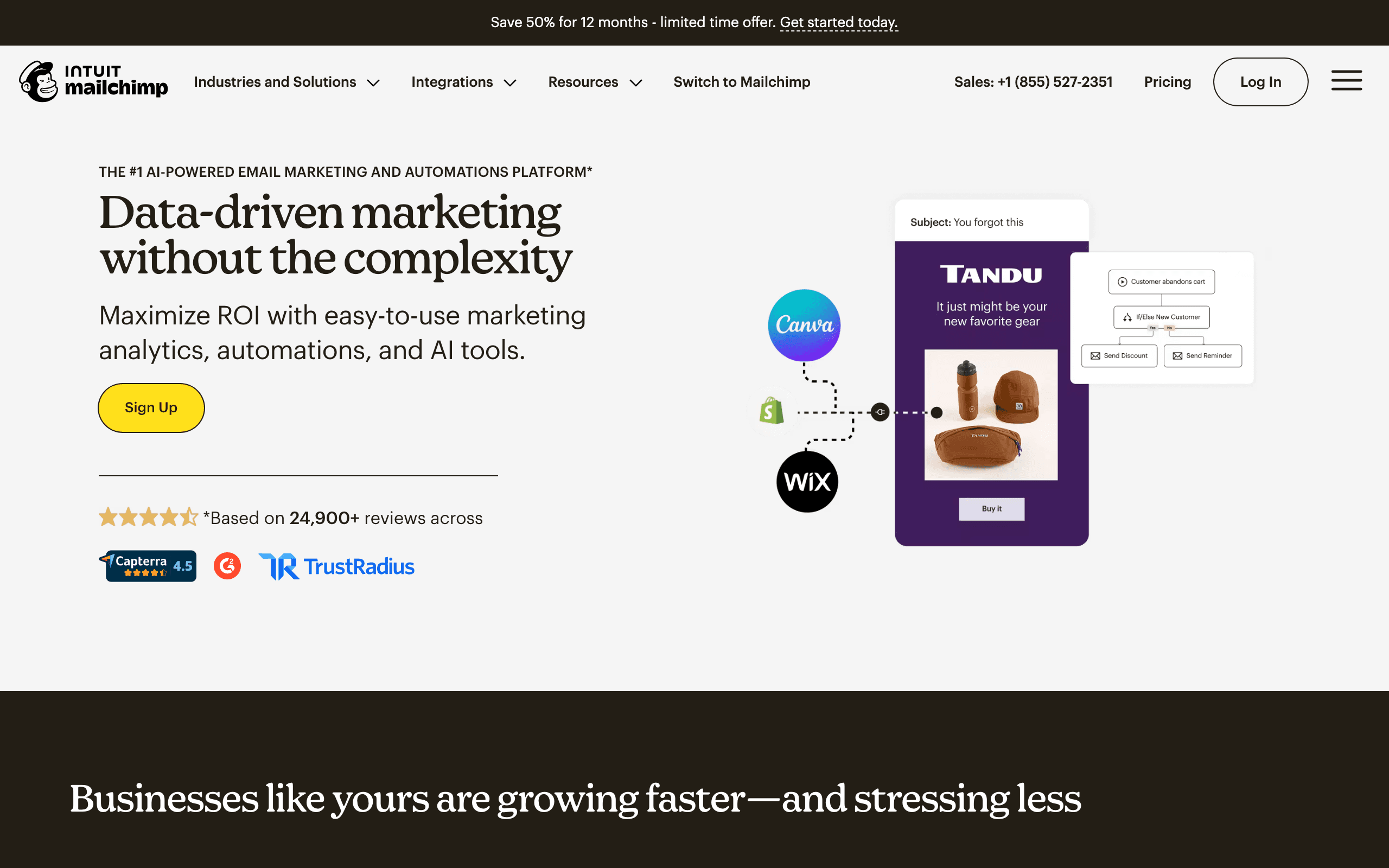
Mailchimp is a full marketing suite beyond email. Landing pages, Facebook and Instagram ads, basic CRM, postcards, even website building. It's trying to be your complete marketing platform.
Mailmodo focuses on email with AMP features. No landing pages, no ads, no CRM. It does one thing differently rather than many things adequately.
When Each Platform Shines
Choose Mailmodo when: Your audience is Gmail-heavy. You need in-email forms or surveys. You want to test innovative email approaches. Higher engagement matters more than universal reach.
Choose Mailchimp when: You need a complete marketing platform. Your audience uses diverse email clients. You want landing pages and ads integrated. Reliability matters more than innovation.
For SaaS Companies
Neither platform is built for SaaS. Mailmodo's interactive features could work for feedback collection, but don't address subscription management. Mailchimp is too broad and general.
For Stripe integration and subscription-aware automation, consider Sequenzy. It costs less than both ($49 vs $78-100) while focusing on what SaaS companies actually need.
Platform Breadth vs Depth
Mailchimp has evolved from an email tool into a comprehensive marketing platform. Landing pages, social media ads, basic CRM, postcards, website builder, and e-commerce integrations surround its email capabilities. For small businesses wanting one platform for multiple marketing needs, this breadth has genuine value.
Mailmodo took the opposite approach: going deeper on a single dimension. AMP email technology allows interactive elements that no other mainstream platform offers. This depth creates a unique capability but at the cost of breadth. Businesses choosing Mailmodo typically need additional tools for landing pages, ads, and CRM.
The Community and Resources Factor
Mailchimp is the largest email marketing platform in the world. This means more tutorials, more templates, more agencies with Mailchimp expertise, and more third-party integrations. When you encounter a problem, someone has likely solved it and documented the solution.
Mailmodo, as a newer and smaller platform, has fewer resources available. AMP email is a specialized technology with a smaller knowledge base. For teams that rely on community support and external resources, Mailchimp's ecosystem provides more assistance.
Email Client Split Decision
Mailmodo's AMP limitation creates a split experience in your subscriber list. Gmail users get interactive forms and surveys. Outlook and Apple Mail users get standard HTML with traditional links. This inconsistency means you are effectively managing two email experiences for every campaign.
Mailchimp delivers a consistent experience to every subscriber regardless of their email client. What you design is what everyone sees. For brands where consistent customer experience matters, this uniformity is valuable.
Mailchimp's Integration Ecosystem as the Decisive Advantage
Mailchimp connects to over 300 platforms — e-commerce, CRM, analytics, social media, and advertising tools. This ecosystem means your email marketing data flows into and out of virtually any business tool you already use. Zapier and native integrations cover edge cases that direct connections miss.
Mailmodo's integration list is growing but cannot match two decades of Mailchimp partnerships. Businesses with complex tech stacks that depend on data flowing between multiple platforms will find Mailchimp's connectivity more practical. Mailmodo's AMP innovation is genuinely unique, but an email platform that cannot easily connect to your CRM, analytics, or e-commerce stack creates data silos that limit its effectiveness.
The Audience Size Penalty in Mailchimp's Pricing
Mailchimp charges based on contact count, and the pricing escalates steeply as lists grow. Unsubscribed and inactive contacts still count toward your bill unless manually archived. At 50,000 contacts, Mailchimp's Standard plan exceeds $350/month — a significant cost for businesses where email is one of several marketing channels.
Mailmodo's per-subscriber pricing is also contact-based but starts lower for equivalent list sizes. More importantly, the comparison reveals a pricing model problem shared by both platforms: contact-based billing penalizes list growth. Businesses with large but infrequently-emailed lists pay for contacts sitting idle. For cost-conscious teams, understanding the true per-contact cost at your expected scale is essential before committing to either platform.
Why Software Subscription Businesses Need a Different Tool Category
Both Mailchimp and Mailmodo serve product marketing, content businesses, and e-commerce effectively. Neither platform natively handles the specific needs of SaaS companies — transactional email for receipts and notifications, billing event-triggered sequences, or subscription lifecycle automation. Running Mailchimp or Mailmodo for marketing alongside a separate transactional service fragments your email infrastructure.
Sequenzy at $49/month unifies marketing campaigns and transactional email with native Stripe integration. Subscription events like trial expiration, payment failure, and plan changes drive automated sequences without separate tools or manual workflow configuration. For software businesses, this purpose-built approach replaces the need to adapt general marketing platforms to subscription revenue models.