Real-World Testing: What Actually Matters
I've spent weeks testing both platforms, and the experience reveals nuances the feature list doesn't capture.
Campaigner feels like enterprise software. The interface is powerful but dense with options. I set up a multivariate test with 5 subject lines and 3 content versions, and the reporting was excellent—clear winner identification with statistical significance. But getting there required navigating through multiple menus and understanding A/B/N testing methodology. This isn't a platform for casual users.
The automation builder is legitimately impressive. I created a workflow that segmented based on email engagement, website behavior, and purchase history, then sent different sequences to each segment. This level of sophistication isn't possible in most platforms. But it took 90 minutes to build and test, even with my experience.
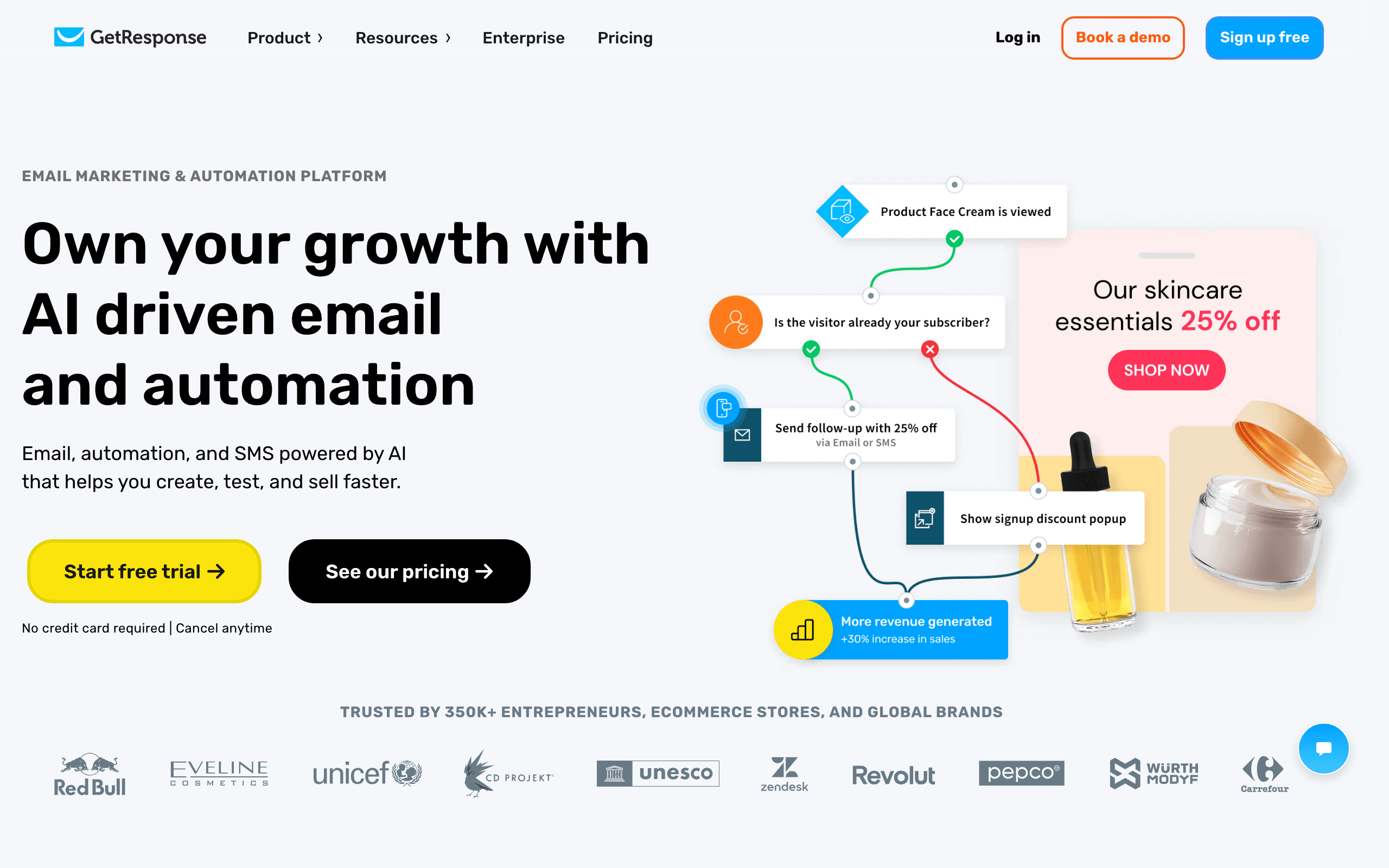
GetResponse surprised me with how much it includes. Within an hour of signing up, I had created a landing page, set up a webinar, and built an automation sequence. The AI email writer generated decent subject lines and body copy—not perfect, but a good starting point. For someone building a complete marketing funnel, having everything in one place is genuinely valuable.
The webinar platform works well. I hosted a test webinar with 50 attendees, and the audio/video quality was solid. Screen sharing, polls, and Q&A all functioned without issues. Automatic replay emails went out to registrants who missed it. This alone justifies the $59/mo for businesses that rely on webinars.
For SaaS companies, both platforms fall short on the most important feature: native Stripe integration. I tried connecting Stripe via Zapier with both platforms, and it works but adds latency and failure points. When a payment fails, you want that dunning email to go out immediately, not after Zapier polls for changes. Learn more about email automation for SaaS.
Where Campaigner Legitimately Wins
Multivariate testing is enterprise-grade. Most platforms test A vs B. Campaigner tests A vs B vs C vs D vs E with multiple variables (subject, content, send time). For high-volume senders optimizing every percentage point of conversion, this is worth paying for.
Template library is massive at 900+. Every industry, every use case, multiple brand styles. If you're an agency sending campaigns for diverse clients, you'll find templates that work. GetResponse's 500+ templates are good, but Campaigner's selection is unmatched.
Segmentation depth handles complex queries. Combine dozens of conditions with AND/OR logic, create dynamic segments that update in real-time, score leads based on engagement patterns. GetResponse segmentation is functional, but Campaigner's is more sophisticated.
E-commerce automation for Shopify and Magento is more advanced. Product recommendations based on browse history, abandoned cart with dynamic product images, post-purchase upsell sequences—it's all built in and tested at scale.
Where GetResponse Legitimately Wins
Webinar platform eliminates the need for Zoom Webinar ($79/mo) or dedicated webinar software. Host up to 1,000 attendees, record sessions, run polls, share screens, and automatically follow up with registrants. For coaches, consultants, and B2B businesses, this alone justifies the subscription. Check out our guide on building effective email funnels.
Landing page builder is included with unlimited pages. Templates for opt-ins, sales pages, thank you pages, all with A/B testing. Campaigner doesn't offer this at all, so you'd need Unbounce ($99/mo) or Leadpages ($49/mo) separately.
Conversion funnels tie landing pages, email sequences, and webinars together. Build complete customer journeys from ad click to purchase. Campaigner focuses only on the email portion, requiring separate tools for the rest of the funnel.
AI email features help with writer's block. Generate subject lines, improve email copy, suggest content based on your industry. It's not as comprehensive as Sequenzy's full sequence generation, but it's useful for speeding up campaign creation.
Free plan (500 contacts) lets you test before committing. Campaigner only offers a trial. For startups validating ideas, GetResponse's free tier is valuable.
Better pricing at $59/mo vs $179/mo is 67% cheaper for the same contact count. Even without the extra features, this price difference is significant.
Honest Limitations of Both Platforms
No native Stripe integration. SaaS companies need emails triggered by subscription events (trial ending, payment failed, upgrade, churn). Both platforms require Zapier or custom webhooks, which adds latency, costs, and potential failure points. Sequenzy's native integration handles this automatically. See our Stripe integration documentation.
No transactional email. Both are marketing-only platforms. You'll need SendGrid, Postmark, or AWS SES for password resets, receipts, and account notifications. Managing two email platforms splits your sender reputation and complicates analytics. Sequenzy unifies transactional and marketing in one platform.
GetResponse automation isn't as deep. While GetResponse automation handles most use cases, it can't match Campaigner's sophisticated branching logic and advanced triggers. If your customer journey is complex, GetResponse may feel limiting.
Campaigner lacks modern features. No webinars, no landing pages, no AI writing assistance. You're paying $179/mo purely for email capabilities. If you need a complete marketing stack, GetResponse's bundled approach is more cost-effective.
Migration Considerations
Moving from Campaigner to GetResponse makes sense if you want to consolidate tools and reduce costs. Export contacts (CSV), import to GetResponse, rebuild workflows. You'll lose some automation sophistication but gain webinars, landing pages, and significant cost savings. Budget 1-2 weeks for migration.
Moving from GetResponse to Campaigner is usually an upgrade in email sophistication but a downgrade in overall marketing features. Only makes sense if email automation is your primary bottleneck and you don't use webinars or landing pages.
Moving to Sequenzy from either works well for SaaS companies. Import contacts, connect Stripe, and use pre-built templates for trial conversion, onboarding, and churn prevention. Most migrations complete in 2-3 days. Check our migration guide for details.
Pricing Reality Check
At 10k subscribers:
- Campaigner: $179/mo (email only)
- GetResponse: $59/mo (email + webinars + landing pages + funnels)
- Sequenzy: $49/mo (email + transactional + Stripe integration + AI)
Campaigner's premium pricing is justified only if you need enterprise-grade email automation and testing. For most businesses, you're paying for features that go unused.
GetResponse's $59/mo is excellent value. You're getting multiple tools that would cost $200+/mo separately (email platform, webinar software, landing page builder). If you use even two of these features, it's worth it.
Sequenzy at $49/mo targets SaaS companies specifically. You get native Stripe integration, AI sequence generation, and unified transactional + marketing email. No webinars or landing pages, but those aren't priorities for SaaS retention and growth. See our pricing page for details.
Final Recommendation
Choose Campaigner if you're:
- Running enterprise-level email campaigns
- Need sophisticated multivariate testing
- Building complex automation workflows
- Comfortable with powerful but complex tools
- Don't need webinars or landing pages
Choose GetResponse if you're:
- Building complete marketing funnels
- Running webinars regularly
- Need landing pages and email together
- Want AI email assistance
- Looking for all-in-one value
Choose Sequenzy if you're:
- A SaaS company using Stripe
- Want AI-generated email sequences
- Need transactional + marketing unified
- Focus on retention and growth automation
GetResponse offers significantly better value than Campaigner for most use cases. The only reason to choose Campaigner is if you specifically need its advanced email automation capabilities and don't care about webinars, landing pages, or cost.
For SaaS companies, neither is ideal—both lack native Stripe integration and transactional email. That's why we built Sequenzy. Check our feature comparison to see if we're a better fit for your SaaS business.
The 3x Price Difference Calculation
At 10,000 subscribers, Campaigner costs $179/month versus GetResponse's $59/month. That $120 monthly difference ($1,440 annually) needs to deliver measurable ROI to justify itself. Campaigner's advantages over GetResponse are multivariate testing, deeper automation branching, and more consistent deliverability. The question is whether those advantages generate $1,440+ in additional value per year.
For high-volume e-commerce senders generating $50,000+/month in email-attributed revenue, a 2-3% conversion improvement from multivariate testing could easily exceed $1,440 annually. For these businesses, Campaigner's testing capabilities are a legitimate investment rather than an expense.
For businesses sending weekly newsletters, monthly product updates, or lead nurture sequences, the incremental value of multivariate testing over A/B testing is marginal. GetResponse's automation handles these standard workflows adequately at one-third the price. The $1,440 saved annually is better spent on content creation, list growth, or complementary marketing tools.
The total cost comparison gets worse for Campaigner when you factor in what GetResponse bundles free. Replacing GetResponse's webinar hosting costs $79+/month (Zoom Webinar). Replacing its landing pages costs $49+/month (Leadpages). Campaigner users who need these tools face a total cost of $300+/month versus GetResponse's $59.
The Webinar Advantage for Lead Generation
GetResponse is the only major email marketing platform with built-in webinar hosting. This creates a unique closed-loop marketing workflow: promote a webinar via email, capture registrants on a GetResponse landing page, host the webinar within the platform, and follow up with automated email sequences based on attendance behavior. The entire lead generation funnel operates within one tool.
Campaigner cannot host webinars. Building an equivalent workflow requires GetResponse or a separate webinar platform plus integration middleware. The friction of connecting multiple tools means fewer businesses build these funnels, reducing the potential ROI of their marketing stack.
For coaches, consultants, and B2B companies that rely on webinars for lead generation, this single capability justifies GetResponse over Campaigner regardless of automation depth. The time saved by having webinar-to-email-sequence workflows pre-built and integrated within one platform represents hours per webinar that would otherwise be spent on cross-platform coordination.
The AI Feature Gap
GetResponse includes AI-powered email writing assistance that generates subject lines, improves body copy, and suggests content based on your industry. Campaigner has no AI features. While GetResponse's AI is not revolutionary - the suggestions need editing and the output is generic - it addresses a real problem: writer's block.
Marketing teams sending multiple campaigns per week spend significant time on copywriting. GetResponse's AI reduces the time from blank page to first draft. Campaigner users start from templates (900+ of them) but still need to write original copy for every campaign. The AI advantage saves 15-30 minutes per email, which compounds over dozens of campaigns per month.
For SaaS companies, GetResponse's AI and Campaigner's templates both miss the mark. Neither platform understands subscription business messaging. Sequenzy's AI sequence generation creates complete email sequences optimized for SaaS use cases - trial conversion, onboarding, churn prevention, dunning - with messaging that reflects subscription business dynamics rather than generic marketing patterns.