Omnisend's pricing page
Captured from omnisend.com. Pricing changes often, so confirm the current numbers on the live page.
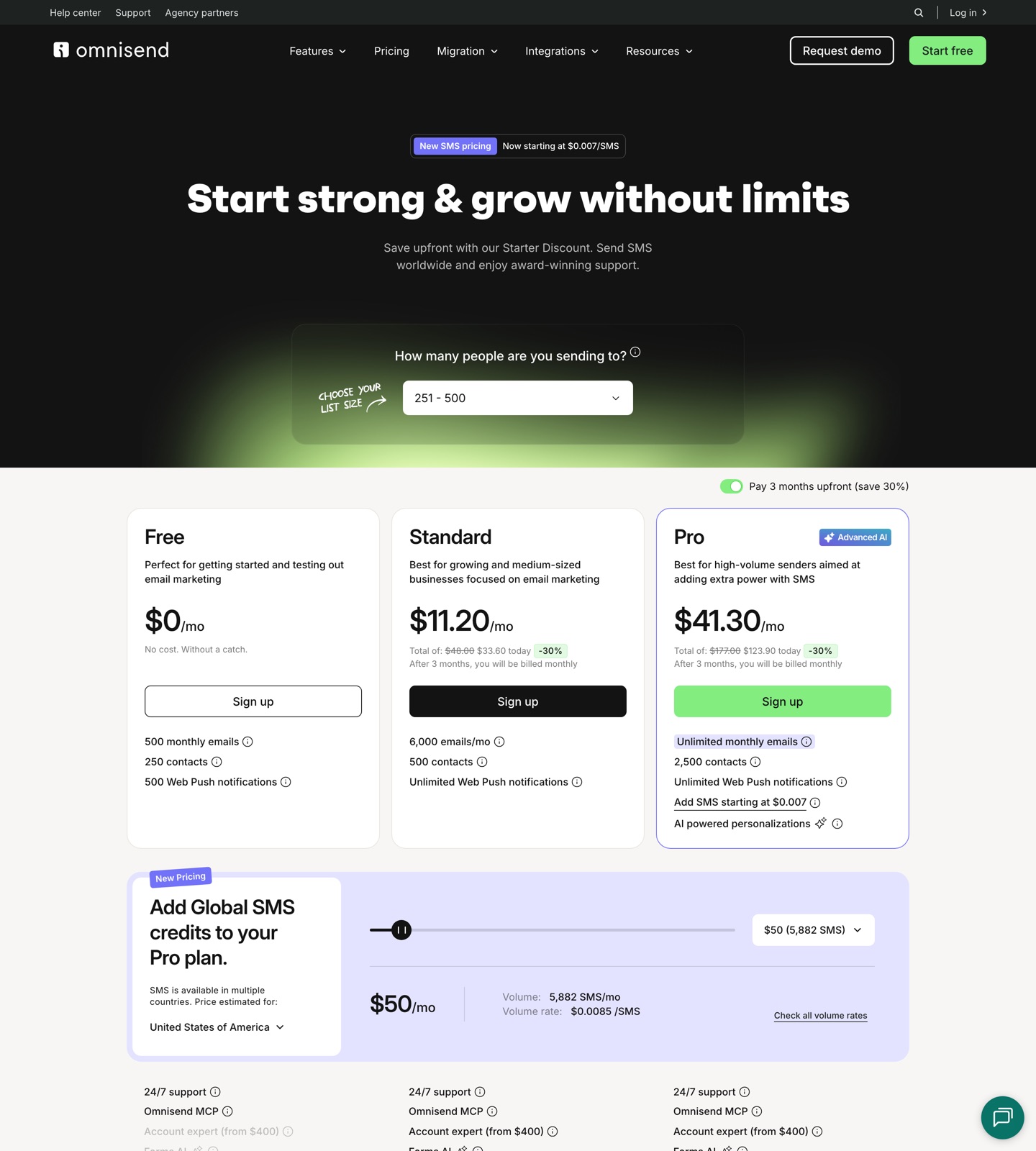
Buying shortcut
Which Omnisend plan should you choose?
Start here
Free
New stores testing ecommerce email automation. It is the first tier to check when you only need the core Omnisend workflow. Watch for: Low email send limit
Public price
$0
Up to 500 emails/month to 250 contacts. No credit card required.
Main upgrade
Standard
Stores growing email revenue with regular campaigns and automations. Inspect this tier when the lower tier starts blocking reporting, automation, collaboration, or support needs. Watch for: Not unlimited email volume
Public price
From $16/mo
From $16/mo for 500 contacts; $132/mo at 10,000 contacts. Email sends up to 12x list size. SMS is not available on Standard for new subscribers.
High-volume or advanced
Custom
Larger ecommerce teams with high-volume needs. Treat this as the serious-operations tier, especially if the first two plans leave key limits or add-ons unresolved. Watch for: Requires sales conversation
Public price
Custom
Sales-led custom plan.
What Omnisend costs at your size
The cheapest plan that covers each size, from Omnisend's published pricing. Check the sources below for the date it was verified.
Cost scenarios
Pricing pages show the entry point. These scenarios show what the plan means in real buying situations.
Shopify store with email and SMS flows
Omnisend: Standard or Pro depending on list size and SMS usage. Sequenzy: Email-only lifecycle pricing. Omnisend is better if SMS and ecommerce revenue workflows are central.
SaaS with a large inactive user base
Omnisend: Contact-based pricing can rise with users. Sequenzy: Unlimited contacts with email-volume pricing. Sequenzy is usually a cleaner SaaS fit.
Store sending frequent promos to the full list
Omnisend: Pro may be needed for unlimited sends. Sequenzy: Based on email volume, without ecommerce SMS features. Omnisend's Pro plan makes sense when ecommerce campaigns drive revenue.
What to watch for
Standard email volume is tied to list size, while Pro is the practical option for heavier senders.
SMS credits and ecommerce features are part of the pricing decision.
Contact-based pricing can be inefficient for SaaS user databases.
Costs beyond the headline price
- Billable contacts include subscribers plus non-subscribers, so checkout and abandoned cart contacts can push you into a higher tier even if they never get campaigns.
- Your tier adjusts automatically each billing cycle as the list grows or shrinks, with an email notice before an upgrade.
- SMS on Pro costs extra through a separate credits subscription, with US rates from $0.009 down to $0.007 per message as monthly SMS spend rises.
- Standard add-ons for Personalized Content and Personalized Sending Time are billed by contact tier, and a dedicated Account Expert is included only on plans of $400 per month or more.
- New subscribers can save 30 percent by paying 3 months upfront, and billing returns to the regular monthly price after that period.
Omnisend pricing is ecommerce pricing
Omnisend is designed around store growth: abandoned cart flows, product-triggered messages, campaigns, SMS, push notifications, and ecommerce reporting. The pricing reflects that. You pay around contacts and channels because the product is meant to turn those contacts into orders.
For ecommerce brands, that is rational. For SaaS, the same structure can feel misaligned.
The real plan question is channel mix. If email alone drives the program, Standard may be enough until send frequency becomes a constraint. If SMS is central and you use Omnisend's ecommerce reporting to measure revenue, Pro can be easier to justify. A store that sends frequent full-list promotions should also model how contact growth changes the bill, because ecommerce lists often include shoppers who are valuable even when they do not buy every month.
SaaS companies should be more cautious. Product events are not the same as cart events, and an inactive product user is not the same as an ecommerce contact. Before paying for store-first features, compare the Omnisend alternatives and the direct Omnisend comparison to see whether a SaaS-focused workflow is a cleaner match.
Omnisend vs Sequenzy
Omnisend is better for Shopify and ecommerce teams. Sequenzy is better when your lifecycle events come from product usage and billing, not product catalogs and carts.
Choose Omnisend when revenue attribution, product catalog events, cart recovery, and SMS are central to the email program. Choose Sequenzy when onboarding, activation, upgrades, failed payments, expansion, and retention are the events that should drive messages.
Omnisend vs Sequenzy
How Omnisend compares with Sequenzy, which bills on emails sent rather than contact count.
How Sequenzy prices the same volume
Sequenzy price per 1k emails
$0.82 / 1k at $49/mo for 60k emails
Verdict
Omnisend is a strong ecommerce marketing platform, especially if email and SMS work together. It is not the most focused or efficient option for SaaS lifecycle email, where Sequenzy's pricing and workflow model fit better.
FAQ
Sources checked · Jun 17, 2026